Pricing Policies
In Swiftlier, you can use Pricing Policies to set how much Swiftlier charges for products or services. Pricing policies are very flexible and can be used to support all of the common pricing models for education and activity businesses - and many more besides!
Note: Pricing Policies do not determine the payment plans available to customers purchasing a particular service - instalments are determined by the available invoice schedule templates, which in turn determine each customer's invoice schedule. You can read more about invoice schedules here.
Why does Swiftlier use Pricing Policies?
Pricing Policies exist independently from courses and services for ease of management.
For example, in a scenario where all music tuition (regardless of instrument) costs £30 an hour, it is much more convenient to set the policy up once, and then set it against each instrument by selecting a single option from a dropdown, rather than having to configure the detailed pricing 25 times against each individual instrument.
Likewise, if you were to want to increase pricing from £30 to £35 an hour, with pricing policies you need only do this once in one place, rather than cycling through every course.
Like many things in Swiftlier, our approach to pricing is built to provide an efficiency boost in the simplest and most general cases, but also to handle edge cases elegantly as well. To extend the above example, if you had two "premium" instruments for which tuition was £50 per hour, you could set a pricing policy just for those instrument, and select those on the relevant products, leaving the others at the £30 rate.
Pricing and Criteria
Pricing Policies consist of two elements - pricing, and then criteria that determine when the pricing should apply. Together, they enable you to be as general or complex as you need to be with your pricing.
Pricing
Swiftlier supports the following types of pricing:
- Per-session fixed price
Charge a specific amount for each session of a product booked. For example, if there are ten sessions of a course in a given term, a price of £30 per session would give a total price for that short course of £300. This is useful in cases where you have the potential for students to join part-way through the term - e.g. a student joining after lesson 2 would pay £240 instead of the full price. This is also commonly used for sets of one-off courses, for example a suite of half-day single-session holiday courses can have a per-session price that applies to all of them.
- Per-series fixed price
This sets the price at the Series level, as opposed to the session level. If you have a Series of 10 lessons, and a price of £300, in this case any late joiners would still pay £300, as they are still purchasing the series.
- Per-session pricing based on length of session
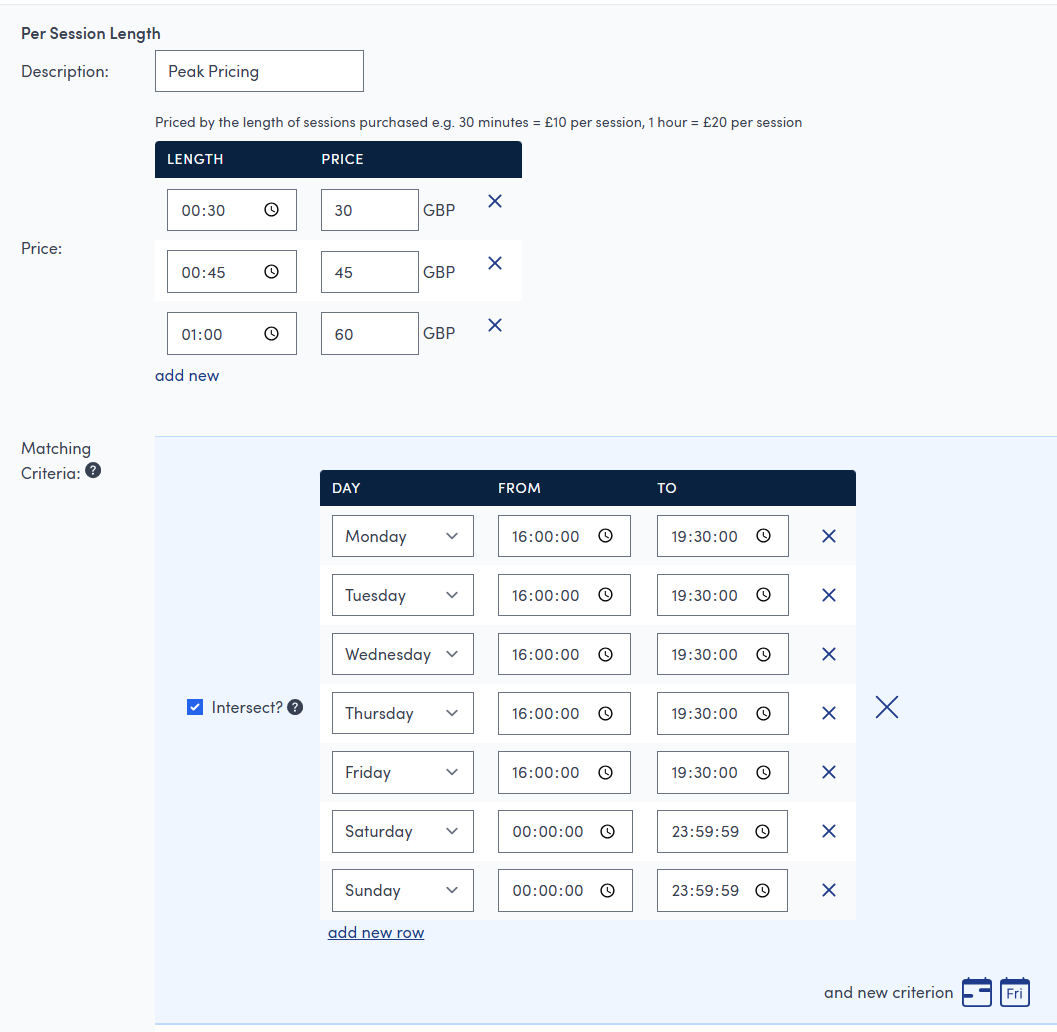
In this model, the pricing is still placed against the session, but it allows you to vary the amount charged based on the length/duration of each session. An example use case for this could be individual tuition, for which you have 45 minute and 90 minute possibilities - booking a series of ten 90-minute lessons should clearly warrant a higher price than ten 45-minute lessons. This allows you to achieve that.
- Per-session pricing based on number of sessions
Again, this model places the pricing on the session, but it enables you to reward customers for committing to longer series with more competitive pricing. For example, this enables you to charge a customer £29 for a single 'Drop In' session of a course, but £25 per session if they commit to the whole series.
Pricing Criteria
Criteria enable you to add variation to when a particular pricing policy applies.
There are two different types of pricing criteria:
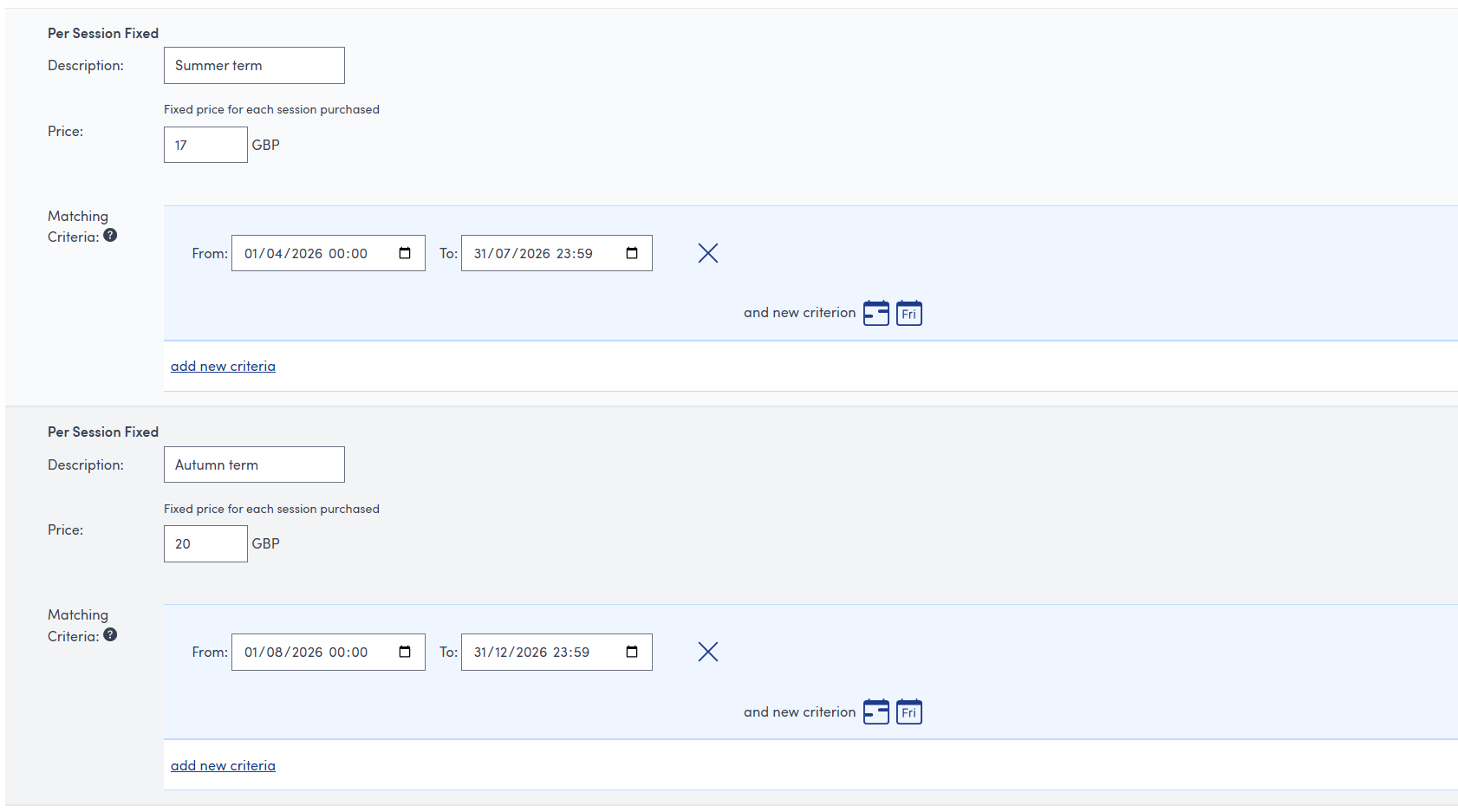
- By date - specify from and to dates for the selected pricing policy to apply. This is useful in cases where you are taking enrolments for the current term (e.g. Summer) and want to concurrently open enrolments for the same course for the next term (Autumn), at an increased price. Please see an example below:
- By time of week - you can use this to set different pricing for the same course based on when the lessons are taking place. For example, if you have a service for which Saturday sessions are selling well, but the same course on Wednesday evenings is not, you can amend the pricing for the Wednesday sessions to a lower price without affecting the price for Saturday. You can also use this criterion to proactively offer on-peak and off-peak pricing for services such as individual tuition, again to encourage people into your quieter times. Please see a screenshot below showing a combination of Per-Session by Length pricing with Time of Week criteria.